History & Timeline
Austrans went from a 1990 concept review to a real, running test vehicle on a real track in Sydney, backed by a AUD $14.3 million federal grant. It never carried a paying passenger. Here is how that fourteen-year arc unfolded.
-
1990
Concept development begins
Work on Austrans starts in earnest with an extensive review of existing automated people-mover and Personal Rapid Transit (PRT) systems worldwide, looking for a design that could beat both PRT and Group Rapid Transit (GRT) on speed and capacity at once.
-
1993
Feasibility study commissioned
Sinclair Knight Merz, one of Australia's leading multidisciplinary consulting firms, is commissioned to examine whether the concept could actually work and what it would cost against conventional light and heavy rail.
-
July 1998
Construction begins on the Sydney test track
Work starts on a 0.5 km test track at Chullora, Sydney. The track is the first of its kind to feature inclined rails and a tight-radius curve, including an 8 metre radius turn through 180 degrees, plus two switches and a 1-in-5 grade on an elevated section.
-
September 2000
The P1 test vehicle is installed
After 16 months of additional design, manufacture, and assembly, the P1 test vehicle, complete with passenger module and interior fit-out, is installed on the track. Key steering and rail-gripping features are demonstrated for the first time on a full-size vehicle.
-
2001
Federal funding secured, newsletter launched
Bishop Austrans, under Managing Director Laurie Bishop, secures a Federal R&D Start Grant of AUD $14.3 million, running through to February 2004. An Austrans Newsletter begins publishing every six months, alongside a public gallery of computer-generated application images.
-
February 2004
An open day, and a search for capital
An independent Sydney rail enthusiast who attends a Chullora open day on 10 February 2004 reports that the system still has no control software written, and that the company is seeking a major investor to fund the next stage. Ideas floated include running an industrial pallet-conveyor service before ever carrying passengers.
-
Mid-2000s
The project quietly winds down
No further public updates follow the 2004 open day. The official austrans.com website eventually goes offline. As of the ITRANS reference page that anchors this archive, development is described simply as no longer active.
The Bishop behind Austrans
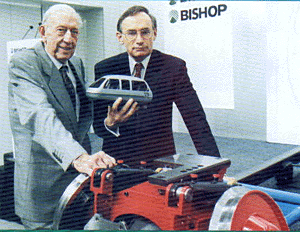
Austrans was developed within the Bishop group of companies, the same Australian engineering house behind Arthur Ernest Bishop's variable-ratio rack-and-pinion steering, technology that at its peak was fitted to roughly one in five cars built worldwide. Late in his career, Bishop turned that same appetite for rethinking mechanical basics toward rail transit, working through the bogie, wheel, rail, and switch problems that had limited rail vehicles for a century.
Bishop Austrans itself was led day to day by Managing Director Laurie Bishop, who steered the project through its feasibility study, test-track construction, and funding rounds. Arthur Ernest Bishop died in 2006; no public record we have found shows Austrans resuming development after his death.