The Technology
Rail is fast and stable, but it corners badly, grips poorly, and runs loud. Over roughly five years, Austrans' engineers developed four patented mechanisms specifically to fix those weaknesses, rather than replacing steel wheel on steel rail entirely as most PRT competitors did.
Self-steering bogie & grip wheels
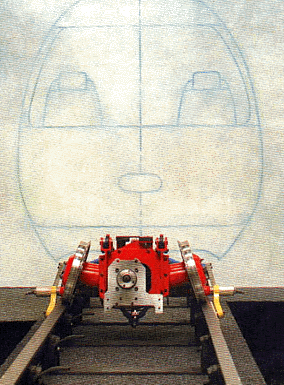
The self-steering bogie lets a vehicle negotiate curves down to an 8 metre radius without relying on flange contact, while staying stable at speeds up to 120 km/h and running considerably quieter than a conventional bogie. To make up for the low traction of steel wheels on steel rail, ancillary grip wheels run along the underside of the rail head, adding enough traction for vehicles to climb 20% grades and brake at a full 0.8g in an emergency.
Z-rail profile & high-speed switch
A special Z-section rail, with running faces inclined inward at 20 degrees, is what allows the self-steering bogie to work at all. Switching was the other rail-technology weak point Austrans set out to fix: a flexing switch arrangement, actuated by stored hydraulic power, banks the rails in a branch-line setting so vehicles can take a diverging route at higher speed and closer spacing than a conventional points mechanism allows. The test track's headway target was 2.5 seconds at 70 km/h.
Vehicle & guideway specifications
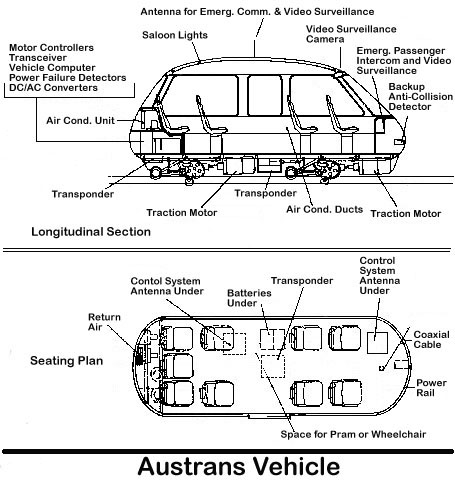
A 9-passenger vehicle was chosen as the best compromise between off-peak economy, on-demand operation, and manufacturing cost.
Vehicle bodies were designed as fibreglass or pressed-aluminium panels over an aluminium or steel frame, with each bogie's main wheel pair driven by an AC electric motor and individual computer-controlled inverter drive. Onboard computers communicated with the central control system over a leaky coaxial cable run in a duct between the Z-rails.
How it compared to PRT and light rail
A 2000s-era comparison of automated transit alternatives placed Austrans in an unusual middle ground: faster and higher-capacity than typical Personal Rapid Transit, but noisier and thirstier than the rubber-tyred systems it was competing against.
Where it won
- Speed & capacityUp to 120 km/h and roughly 9,000 passengers per hour in one direction, above what most PRT systems of the era claimed.
- Guideway efficiencyLarger, shared vehicles were argued to load the guideway more efficiently than single-occupant PRT pods.
- Structure costNarrow gauge and a small loading envelope meant tunnels sized at roughly 36% the cross-section of conventional heavy rail.
Its trade-offs
- Energy useSteel wheel on steel rail used noticeably more energy per vehicle and per passenger than rubber-tyred PRT rivals.
- NoiseDespite the bogie's noise-reduction design, rail-based Austrans still ran louder than rubber-tyred alternatives.
- Unproven at scaleOnly a short test track and a single prototype vehicle were ever built. The switch software was reportedly still unwritten as late as 2004.